

Highlights:
- A few weeks of Hormuz closure will create a domino effect of events that could push crude to $150 or higher, triggering a massive flight to liquidity and a surge in the US dollar.
- Oil has evolved into a strategic macro asset; its price now moves in lockstep with global inflation and central bank policy rather than simple supply and demand.
- To navigate 2026, we must stop asking how much oil is in the tanks and start asking how much risk is in the air. Those who fail to adapt to this structural shift will be left behind by a market that has outgrown its own history.

Brent crude has surged past the $110 mark, and WTI holds firm above $107, marking the fastest oil rally since the 1980s. While the reflex for many is to scrutinise production charts, those looking solely at the physical barrel in 2026 are reading an outdated map.
Since the current conflict began, Brent and WTI have gained 50% and 60% respectively. What started as a localised strike on nuclear capacity has widened into a regional war that has engulfed the Middle East, signaling a structural transformation.
Oil has shed its skin as a mere commodity and emerged as a strategic macro asset — a real-time barometer of geopolitical power, monetary policy, and market sentiment.
Is $150 a Barrel the Next Milestone?
The primary driver behind today's triple-digit prices isn't a shortage of oil in the ground, but the risk premium associated with the Strait of Hormuz. With roughly 20% of global oil trade transiting this narrow corridor, the current escalation between the United States and Iran has created a logistical and psychological bottleneck.
With Iraq already cutting 60% of its production and Kuwait following suit due to these logistical bottlenecks, the physical market is beginning to seize. The threat continues to push prices skyward as traders price in worst-case scenarios. On Friday, Qatar's energy minister Saad Al-Kaabi warned that a closure of Gulf energy exports within weeks could catapult oil to $150 a barrel.
The Widening Gap: Brent vs. WTI Crude
While Brent and WTI often move in tandem, the geopolitical premium on Brent has pushed the spread between the two benchmarks to its widest level in over two years. This gap is due to their different geographic roles: Brent is the international standard most sensitive to Middle Eastern supply, while WTI (West Texas Intermediate) is more reflective of US domestic production.
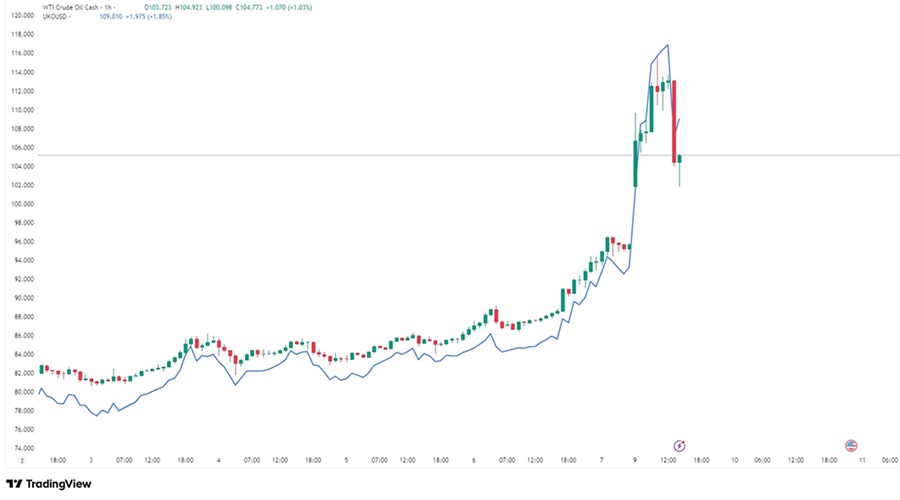
The Hormuz Premium in Real-Time.
This 1-hour chart from March 9, 2026, shows the historic price surge as Brent (UKOUSD) reached $114 per barrel. Note the significant gap up at the start of the week, reflecting the widening spread between global Brent (blue line) and domestic WTI (candlesticks).
In the current crisis, Brent has taken the lead. As the threat to the Strait of Hormuz directly impacts the flow of oil to Europe and Asia, Brent carries a much higher geopolitical premium. WTI has also risen, but it often lags behind Brent because the US has its own domestic production to lean on.
A widening Brent-WTI spread tells us that the crisis is strictly a global shipping and security issue. If the gap begins to close, it often suggests that the problem has shifted from a local Middle East conflict to a total global shortage that is finally hitting American shores.
A New Monetary Mindset: The Flight to Cash
The longer this conflict lasts, the more exponential the damage becomes in a domino effect. When oil prices spike on fear rather than demand, it triggers a risk-off feedback loop across all asset classes. As of Monday morning, the US dollar surged as soaring oil prices sent investors scrambling for cash on worries that a protracted Middle East war could severely disrupt energy supplies and hurt global growth.
The impact on the broader portfolio is immediate. Stocks, bonds, and even precious metals have begun to slide in tandem as investors liquidate profitable positions to seek the safety of the greenback. The prospect of $150 oil suggests that inflationary pressure may force the Federal Reserve to abandon its easing cycle entirely, cementing a higher-for-longer interest rate environment.
This creates a secondary shock: as yields stay elevated to combat energy-driven inflation, the cost of corporate debt rises, further dampening equity valuations.
The End of Supply Safety Net
In previous years, whenever oil prices spiked, the common response would either be OPEC+ countries turning on the taps or US shale companies drilling more wells to flood the market with supply and bring prices down. In 2026, that safety net seems to be gone.
The producers have shifted their mindset from "growth at all costs" to "strategy first." US shale producers are not rushing to boost drilling, constrained by capital discipline and investor demands for returns. Meanwhile, OPEC+ is focused on protecting long-term market share in an era of energy transition. The result is a supply side that is stable but structurally inelastic.
Navigating this landscape requires a departure from traditional mean reversion strategies and taking a cross-asset approach. For example, investors should look at the currencies of countries that import the most energy, as these often drop when oil rises. In the bond market, watching the yield curve is now just as important as watching oil prices, as higher rates often signal that the economy is bracing for impact.
For the stock market, rising oil and rising interest rates are a double whammy for stocks. Higher fuel costs hurt profits while interest rates make borrowing expensive. In this environment, investors often sell off tech or growth stocks and move into safer havens like the US dollar.
The Bottom Line
For the local economy, this means volatility is the new baseline. The era of predictable, supply-driven energy costs is over. We have entered a period where oil is a political instrument and an economic barometer.
To navigate the rest of 2026, we must stop asking how much oil is in the tanks and start asking how much risk is in the air. Those who adapt to this new mindset will find opportunity in the chaos; those who don't will be left behind by a market that has outgrown its own history.
By Nayel Al-Jawabra, Senior Market Analyst, VT Markets