
Preview Mode


Company Review
Axcera Review 2026: Features, Integrations, Pricing, and More
Introduction
Axcera is a trading-technology provider focused on CRM and operational infrastructure for prop firms and brokerages. Its product suite includes Prop CRM, Broker CRM, Trading APIs, and Risk Guard, with the main emphasis on centralised operations, automation, reporting, onboarding, and real-time oversight.
In practical terms, Axcera is positioned for firms that want more control over core workflows, including:
trader or client onboarding
challenge configuration
payouts
compliance workflows
partner management
risk monitoring
Its Prop CRM focuses on configurable challenge logic, automated payout workflows, branded interfaces, and live rule monitoring. Broker CRM is presented around client management, onboarding, payment workflows, regulatory reporting, and centralised brokerage operations.
It also supports operations across Forex, Futures, Crypto, Equities, and multi-asset programs, and uses a transparent licensing model with no revenue share.
Axcera Features and Services
Axcera’s offering is built around four main products: Prop CRM, Broker CRM, Trading APIs, and RiskGuard. Together, these cover firm operations, trader or client management, automation, platform connectivity, and risk oversight for trading businesses.
Product overview
Product | Main Focus | Notable Details |
Funded-account operations | Built for prop firms; supports onboarding, challenge setup, payouts, monitoring, and trader management | |
Brokerage operations | Built for Forex and CFD brokers; currently marked Coming Soon / waitlist | |
Custom trading technology | APIs and SDKs for custom portals, workflows, reports, and backend connectivity | |
Risk detection and protection | Real-time alerts, exposure control, behavioral analysis, and threat detection |
Prop CRM
Prop CRM is the strongest part of the current product stack. It is designed for firms that want to centralise funded-account operations in one system. Axcera highlights the following features:
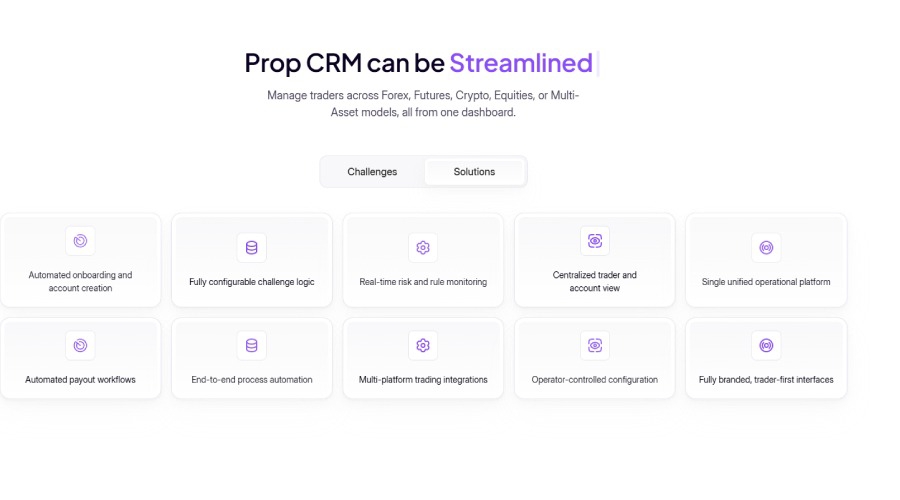
automated onboarding and account creation
fully configurable challenge logic
real-time risk and rule monitoring
centralized trader and account view
automated payout workflows
end-to-end process automation
multi-platform trading integrations
operator-controlled configuration
fully branded trader interfaces
Axcera also presents Prop CRM as supporting Forex, Futures, Crypto, Equities, and Multi-Asset programs from one dashboard.
Broker CRM
Broker CRM is aimed at Forex and CFD brokerage operations and is positioned as a centralised dashboard for managing core brokerage workflows. The main capabilities highlighted include:
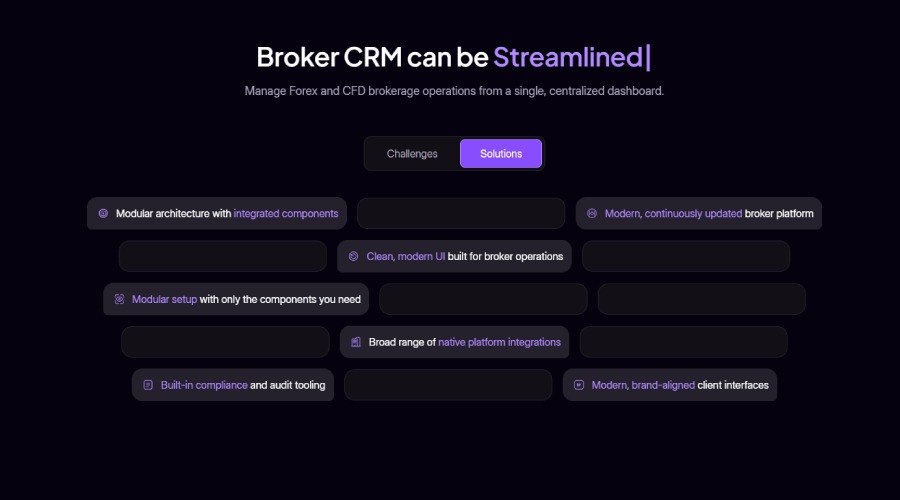
modular architecture with integrated components
modern broker platform and UI
native platform integrations
built-in compliance and audit tooling
client acquisition and retention tools
deposits and withdrawals support
instant account setup
regulatory reporting
One important point is that Broker CRM is currently marked as Coming Soon, so it appears to be at an earlier rollout stage than Prop CRM.
Trading APIs
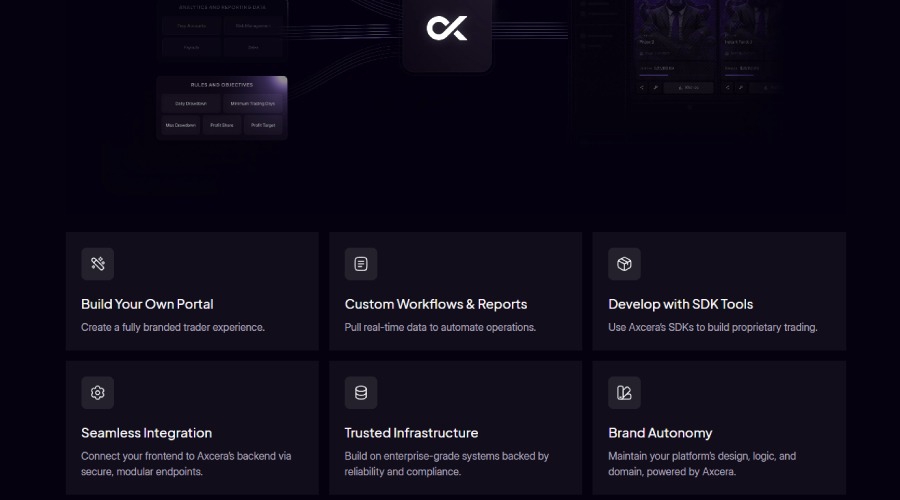
Axcera’s Trading APIs are designed for firms that want to build or extend their trading technology while using Axcera’s backend infrastructure. The API layer focuses on flexibility rather than a fixed front-end setup. Key points include:
APIs and SDKs for custom development
custom portals and branded user experiences
real-time workflows and reporting
secure, modular endpoints
enterprise-grade infrastructure
brand autonomy over design, logic, and domain
150+ platform integrations listed on the product page
RiskGuard
RiskGuard is Axcera’s dedicated risk layer and is built to detect and respond to trading threats in real time. It is positioned as a separate protection layer for prop firms and brokers that want stronger oversight across trading activity. Axcera highlights:
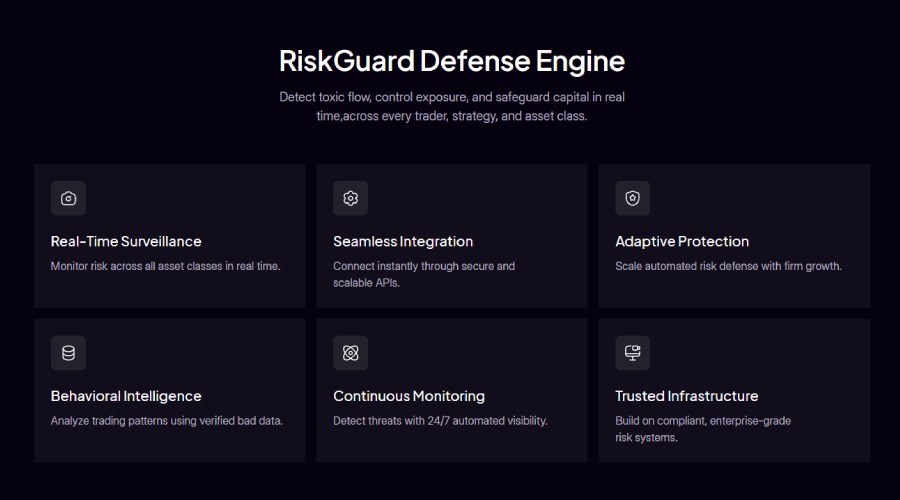
automated detection and real-time alerts
toxic flow and exposure monitoring
behavioral intelligence
adaptive risk engine
seamless API-based integration
continuous 24/7 monitoring
The page also references several risk-related metrics:
RiskGuard Metrics | Details |
Accounts monitored monthly | 100K+ |
Average threat detection time | 100ms |
Verified bad actor records | 10,000+ |
Monitoring coverage | 24/7 |
Overall service offering
Taken together, Axcera is positioned as more than a standalone CRM. The broader value proposition is a connected operating stack that combines CRM workflows, automation, APIs, integrations, and risk management in one environment for prop firms and brokerage businesses.
Axcera Integrations and Technology
Integration Breadth
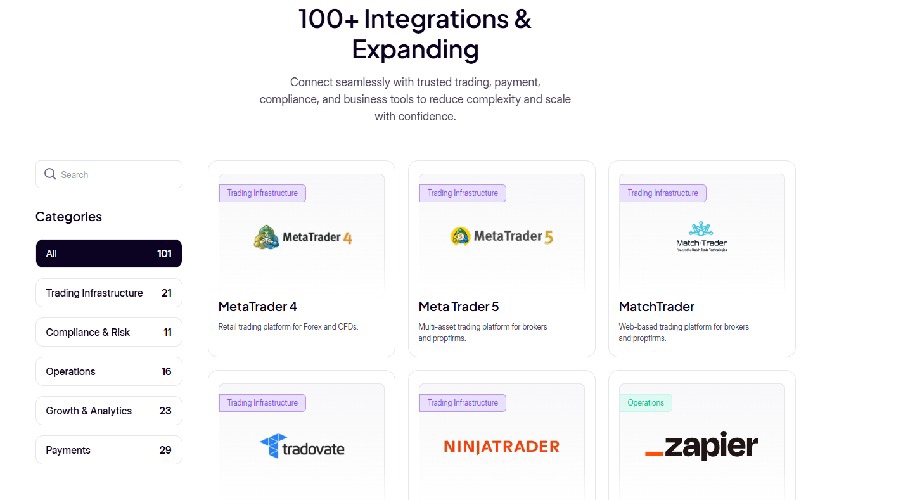
Axcera places heavy emphasis on connectivity. It presents an ecosystem of 100+ integrations covering core business areas such as the following:
trading infrastructure
compliance and risk
operations
growth and analytics
payments
This broader integration coverage helps reduce friction between trading systems and third-party business tools.
Integration Categories at a Glance
Category | Focus |
Trading Infrastructure | Platform connectivity for brokers and prop firms |
Compliance & Risk | Verification, monitoring, and control workflows |
Operations | Messaging, automation, and business process tools |
Growth & Analytics | Reporting, analytics, and marketing-related tools |
Payments | Deposit, payout, and e-commerce-related integrations |
Trading Platform Support
The integrations library includes several trading-platform names commonly used by brokers and prop firms, including:
Match-Trader
Tradovate
NinjaTrader
This gives Axcera coverage across both Forex/CFD and futures-oriented environments.
Payments, Operations, and Business Tools
Axcera’s integrations extend beyond trading platforms. The current library also includes tools such as the following:
Stripe for payment processing
Zapier for workflow automation
Intercom for customer messaging and support
Customer.io for behavior-based messaging and automation
WooCommerce and Shopify for e-commerce-related workflows
This suggests the platform is designed to support not only CRM records, but also the wider operational side of onboarding, payments, communication, and automation.
API and SDK Infrastructure
Axcera’s technology stack is not limited to prebuilt integrations. Its Trading APIs and SDKs are positioned as a production-ready foundation for firms that want to build or extend their own trading technology.
Key points highlighted include the following:
APIs and SDKs for custom development
custom portals and branded user experiences
real-time workflows and reports
secure, modular endpoints
enterprise-grade infrastructure
flexibility over design, logic, and domain
This makes the platform more flexible than a closed CRM system, especially for firms that want to keep their own frontend while using Axcera for backend infrastructure.
Custom Integration Flexibility
Axcera states that clients can request new integrations that are not currently listed. It also says new integrations are prioritised based on the following:
client demand
operational impact
security and compliance considerations
ecosystem value
The platform further notes that partner solutions can be embedded directly where applicable.
Overall Technology Take
From a review perspective, Axcera’s technology offering stands out where CRM, automation, API flexibility, and platform connectivity overlap. It is not presented as just a client database or a basic back-office panel. It is positioned as a broader operating layer that connects trading infrastructure, payments, communication tools, analytics, and compliance workflows in one environment.
Axcera Pricing and Cost Structure
Pricing model
Axcera uses a transparent licensing model rather than a revenue-share arrangement. The company states that there is no revenue share, and its Prop CRM FAQ adds that pricing is based on a fixed-fee model with no per-trader pricing and no hidden fees.
Pricing at a glance
Pricing Factor | Details |
Commercial model | Transparent licensing |
Revenue share | No |
Per-trader pricing | No |
Hidden fees | Not stated as part of the model |
Public plan pricing | Not published |
Quote process | Demo / sales conversation |
The main advantage of this structure is cost predictability, especially for firms that do not want technology costs to rise with every additional trader.
Public pricing visibility
Axcera does not publish public package prices or plan tiers. Instead, the site directs prospective clients toward Book a Demo, Talk to an Expert, or the Broker CRM waitlist. That means a direct price comparison with competing CRM providers is not possible from the published information alone.
Rollout and implementation
The Broker CRM page outlines a staged process built around three phases:
Onboarding
Build & Configure
Launch & Scale
According to Axcera, this process covers alignment on the brokerage model, trading platforms, payment providers, regulatory scope, operational requirements, integrations, client workflows, permissions, compliance rules, and reporting. This suggests the commercial setup is likely tied to implementation scope rather than a simple off-the-shelf subscription.
Pricing takeaway
Axcera’s pricing model appears strongest for firms that want:
fixed and more predictable platform costs
no revenue-share arrangement
no per-trader pricing model
The trade-off is lower upfront pricing transparency, since firms need to go through a sales or demo process to get a tailored quote.
Support Overview
Axcera presents support as a core part of its service offering, with 24/7 support coverage across its main product and company pages. This is especially relevant for CRM and operations software, where delays can affect onboarding, payouts, reporting, platform connectivity, and day-to-day workflows.
Support at a Glance
Support Area | Details |
Availability | 24/7 support coverage |
Contact Channels | Contact form, email, demo booking, LinkedIn |
Main Email | hello@axcera.io |
Response Time | Most enquiries are answered within one business day |
Escalation | Urgent technical issues can be escalated to engineering |
Support Style | Guided, consultative, and hands-on |
Contact Channels
Axcera offers several ways for firms to get in touch:
contact form
email
demo booking
LinkedIn
The contact page is clearly geared toward product demos, onboarding discussions, and partnership conversations, which suggests a more consultative support and sales process rather than a purely self-serve model.
Response Times and Escalation
Axcera states that most enquiries receive a reply within one business day. It also notes that active clients can access priority support through dedicated communication channels, with urgent technical issues escalated directly to the engineering team.
Onboarding Experience
The onboarding process appears to follow a managed implementation model rather than instant self-service signup. The Broker CRM flow is structured around three phases:
Onboarding
Build & Configure
Launch & Scale
This process includes alignment on:
brokerage model
trading platforms
payment providers
compliance requirements
reporting setup
operational workflows
That approach may suit firms that want closer vendor involvement during setup and rollout.
Global Coverage
Axcera lists offices in Dubai and Limassol and also mentions remote teams across Europe, Asia, and North America. This broader footprint supports its 24/7 support positioning and suggests coverage across multiple time zones.
Support Takeaway
Axcera’s support model appears stronger on:
availability
guided onboarding
direct access to the team
escalation for urgent technical issues
The trade-off is that the model looks more service-led than self-serve, which may suit firms looking for hands-on implementation and ongoing operational support.
Axcera Pros and Cons
Pros | Cons |
Broad product stack across Prop CRM, Broker CRM, Trading APIs, and RiskGuard | No public pricing table or published plan tiers |
100+ integrations across trading, payments, compliance, and operations | Broker CRM is still marked as coming soon / waitlist |
Fixed-fee model with no revenue share and no per-trader pricing | More guided implementation than instant self-serve onboarding |
Strong prop-firm feature set with automation, challenge controls, and payout workflows | Limited public detail on feature packaging and plan differences |
Dedicated risk layer with real-time monitoring, 100ms average threat detection, and 10,000+ verified bad actor records | Current product maturity appears stronger for prop firms than for brokers |
24/7 support coverage |
Final Verdict
Axcera stands out as a strong option for firms looking for more than a basic CRM. Its product stack combines Prop CRM, Trading APIs, RiskGuard, and a broader integrations layer, making it more suitable for businesses that want one connected operating environment for onboarding, automation, reporting, and risk control rather than a standalone back-office tool. The platform also highlights 100+ integrations, 24/7 support coverage, and a transparent licensing model with no revenue share.
The clearest strength in the current product mix is the prop-firm side. Axcera presents itself as trusted by 50+ prop firms worldwide, while Prop CRM is positioned around automated onboarding, configurable challenge logic, automated payouts, and real-time monitoring. RiskGuard adds another strong layer with 100K+ accounts monitored monthly, 100ms average threat detection time, 10,000+ verified bad actor records, and 24/7 continuous monitoring.
The main limitation is transparency at the package level and maturity on the broker side. Axcera does not publish public pricing tiers, and Broker CRM is still presented through a waitlist / go-live flow rather than as a fully launched product with openly comparable plans.
Disclaimer: The contents or products outlined on this page are provided by third parties and do not constitute an endorsement or any opinion by Finance Magnates. Finance Magnates has no control of the contents of this page, nor is responsible for its accuracy or legality and hereby waives any responsibility for this content. Any transactions, investments, or engagement that you enter into with a third party listed on this page or linked from this page are solely between you and such third party and are performed at your own risk. Finance Magnates holds no responsibility for any liability, damages, or losses caused in connection with the use of any content on this page.