


Macroeconomic data takes a back seat this week to geopolitics, with events in the Middle East and at the UN General Assembly in New York providing the main cues for market direction. The result has been a more constructive view of the global oil supply picture than was the case in prior weeks. News from Saudi Arabia has been positive: the East-West pipeline appears close to coming back online following damage from drone and missile attacks, while the kingdom’s ship-to-ship transfer workarounds from the Persian Gulf are also helping to ramp up export volumes.
Meanwhile, the presence of US and Iranian delegations on the sidelines of the UN has given traders a glimmer of hope that diplomatic rather than military measures could help lower the temperature in a conflict that has been ongoing since late February. The combination of a reopened diplomatic channel and respectable Saudi export numbers has allowed crude to trade at more tolerable levels for risk assets, at least for now.

While prices have backtracked this week - both Brent and WTI have moved below the psychological $100 level, with WTI trading below $90 - oil could reverse higher quickly if the US-Iran talks fizzle out or if further attacks hit energy infrastructure around the Gulf.
These lower oil prices have taken some of the sting out of bond yields, though absolute levels remain elevated. Since the Fed’s rate hike last week, the Treasury yield curve has flattened, with the spread between the 2-year and 10-year notes compressing. That is not necessarily a positive development given what continued flattening can signal about longer-term growth prospects. The 10-year yield has moved back below 5%, while the 2-year has held firmer in response to the Fed’s hawkish turn. If the curve keeps flattening, it could serve as a cautionary signal that growth may struggle under a high-inflation and higher-rates environment. Ultimately, oil prices are likely to remain the biggest near-to-medium-term influence on bond yields. Sustained lower oil could help ease the Fed’s inflation and high-yield headache in the months ahead.
In FX markets, the Dollar has retained its post-hike strength, with the DXY holding above the 100 handle and last seen around 100.5. The yen remains under pressure following the Bank of Japan’s non-unanimous (7-2) rate hike last week. Despite both the Fed and the BoJ delivering 25 basis-point increases and thereby preserving the nominal rate differential, Governor Ueda’s messaging lacked the hawkish conviction shown by Fed Chair Warsh, leaving the yen on the back foot against the greenback.
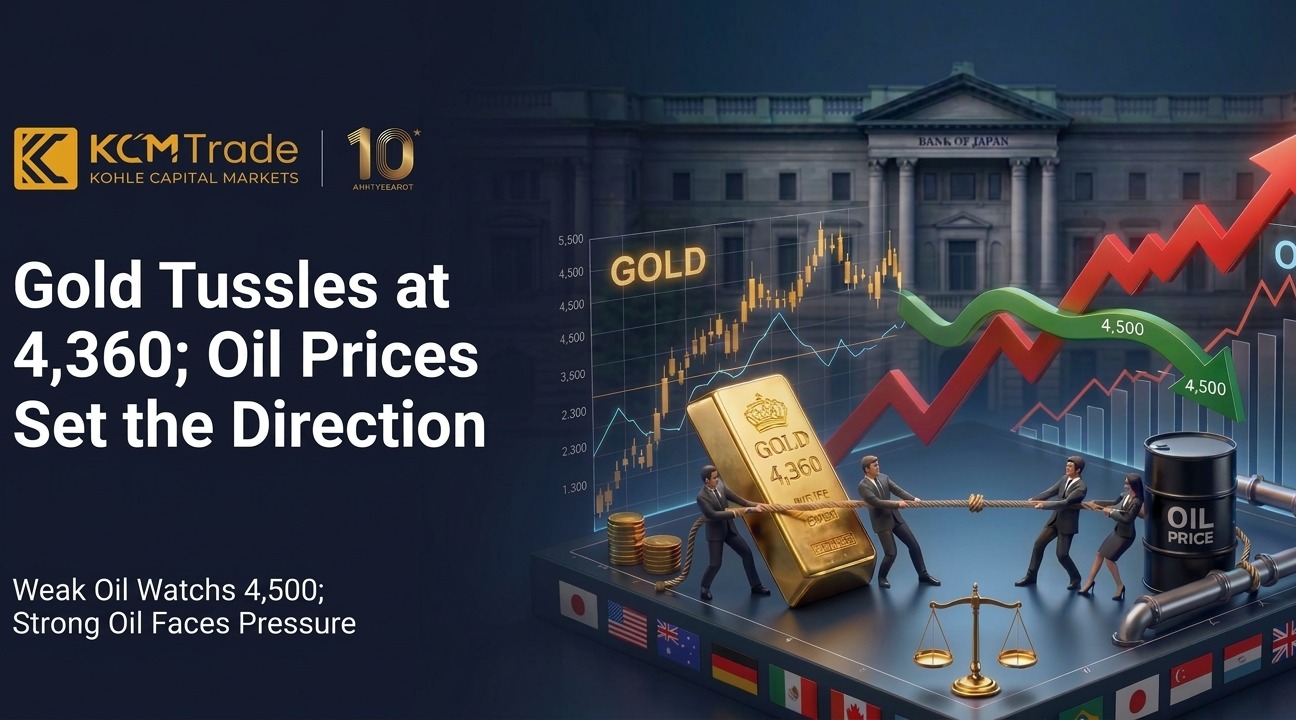
Gold has stabilised after last week’s drift lower in the wake of the hawkish Fed decision, reclaiming the $4,360 area in early Asian trading. Lower oil prices, and the associated scaling-back of near-term inflation expectations, have helped the metal weather this month’s rate hike, while a steady undercurrent of central-bank buying (particularly from China) continues to provide a floor of support. A firm Dollar and elevated Treasury yields remain headwinds, and any sharp rebound in oil would quickly become an obstacle. Should oil continue to ease, however, the path back toward $4,500 could reopen. Near-term levels to watch include support at $4,310 and $4,260, with resistance at $4,390 and $4,510.
Turning to the Trump-Xi meeting later this week (on Thursday), expectations remain quite low. The encounter is widely expected to be more about optics than substantive action. Markets will likely be satisfied if the meeting simply passes without hiccups or fresh flashpoints that could further strain US-China relations. An extension of the existing trade truce, which is due to expire in November, appears the most achievable outcome. More contentious issues, including China’s rare-earth export controls and any meaningful coordination on AI-race guidelines, look set to remain in the “too hard basket” for now.
The macroeconomic calendar is relatively light this week, though US weekly jobless claims on Thursday and a further slate of Fed speakers will be monitored for clues on how many additional hikes may still arrive this year and when. The Nasdaq’s fresh record high on Tuesday underlines that appetite for tech remains robust. For the broader market, the direction of oil and bond yields is likely to remain the dominant influence on risk assets in the days ahead.
In summary - oil is trading at more palatable levels in the eyes of risk assets, but whether it can stay at these more comfortable levels is another matter entirely, with no resolution to the US-Iran war yet on the table.
(Some visual images were created with the assistance of AI technology and are for reference purposes only.)
For the latest official updates and announcements from KCM Trade, visit our newsroom.